Start with the calls that already have known answers
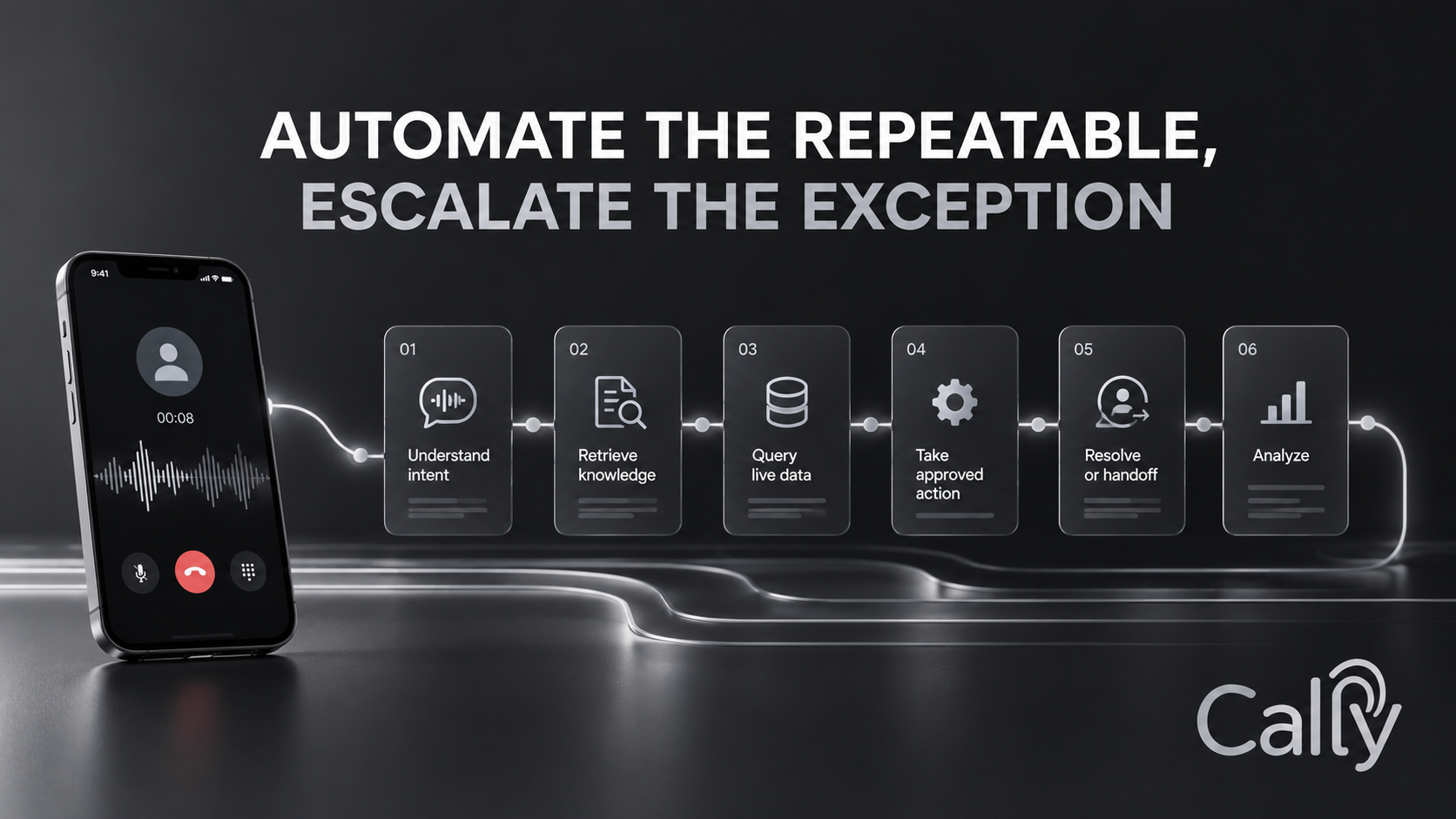
Inbound support contains a mixture of repetitive questions and complex exceptions. The first automation target should be the repetitive portion: order status, appointment information, account procedures, store or service details, simple troubleshooting, and structured ticket creation.
Give the agent two kinds of information
Static guidance belongs in the knowledge base. Live customer or transaction data belongs behind API actions. Cally supports both, so the agent can answer policy questions from uploaded documents and query real-time systems through defined REST actions when the caller needs current information.
Use workflow gates around risk
A support flow can use question nodes to collect identifiers, confirmation nodes before sensitive changes, decision nodes for routing, and handoff nodes for exceptions. The agent stays conversational, but the operation remains governed. This is especially important when one support queue handles both informational and account-changing requests.
Keep supervisors close during rollout
Cally’s live call board, audio listen-in, private whisper, forced transfer, and emergency hangup give supervisors direct visibility during early production. That lets the team observe real caller behavior without pretending the pilot is fully autonomous on day one.
Review outcomes, not anecdotes
After the call, Cally provides recordings, speaker-separated transcripts, action events, goal evaluation, sentiment, extracted fields, and evidence links. The support team can use those artifacts to find repeat failure patterns, refine knowledge, and decide which new intents are ready for automation next.
A strong first inbound pilot is one queue, a small set of intents, one or two trusted data integrations, and a clear human fallback.