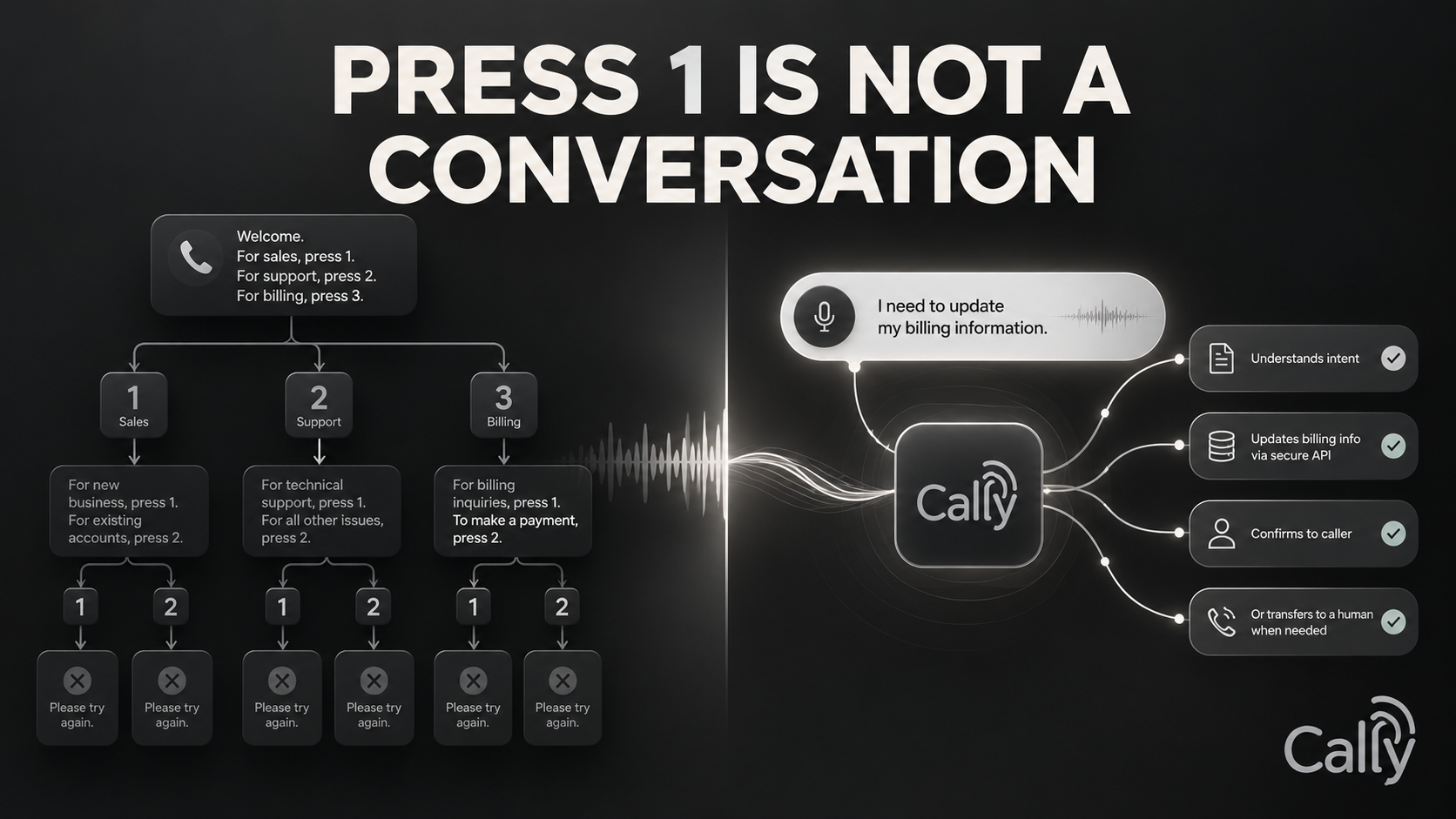
IVR solved routing, not conversation
Traditional interactive voice response systems are excellent at one specific job: guiding callers through a predefined menu. “Press 1 for sales, press 2 for support” is deterministic, cheap, and predictable. But the caller has to translate their real-world problem into the menu structure. When the intent does not match the tree, the experience becomes repetition, misrouting, or an early request for a human.
Voice AI starts from the caller’s language
A conversational voice agent reverses that model. Instead of asking the customer to learn the menu, the system listens to the request in natural language and decides what should happen next. The result can still be deterministic where it matters. Cally’s orchestration studio supports question nodes, confirmation nodes, decision branches, action nodes, suppression checks, and handoff nodes, so teams can combine open conversation with controlled business logic.
The important shift is context
In an IVR, each button press usually represents a narrow choice. In a voice-agent workflow, the system can capture multiple pieces of context during one conversation: who the caller is, what they are asking for, an order number, a preferred appointment time, or whether they have confirmed an action. That context can be reused in later workflow steps or passed into an API request rather than asking the caller to repeat it.
You do not have to throw away telephony
Moving from IVR to conversational automation does not require abandoning an existing PBX or carrier. Cally supports SIP connectivity, bring-your-own-trunk setups, inbound DID routing, and SIP REFER transfers. That means the AI layer can sit in front of, beside, or inside an existing call-center topology. A company can automate selected intents while leaving the rest of the routing model untouched.
A hybrid model is often the strongest model
There are still situations where deterministic menus make sense: legal notices, emergency routing, short authentication steps, or clearly segmented business units. Voice AI is most valuable where the caller’s language is variable but the operational outcome can still be governed. The future is not “AI instead of every IVR.” It is a conversation layer that can use deterministic controls whenever the process demands them.
If your current call flow is a maze of menus, start by identifying the three intents callers most often try to express in their own words. Those are strong candidates for a conversational layer.