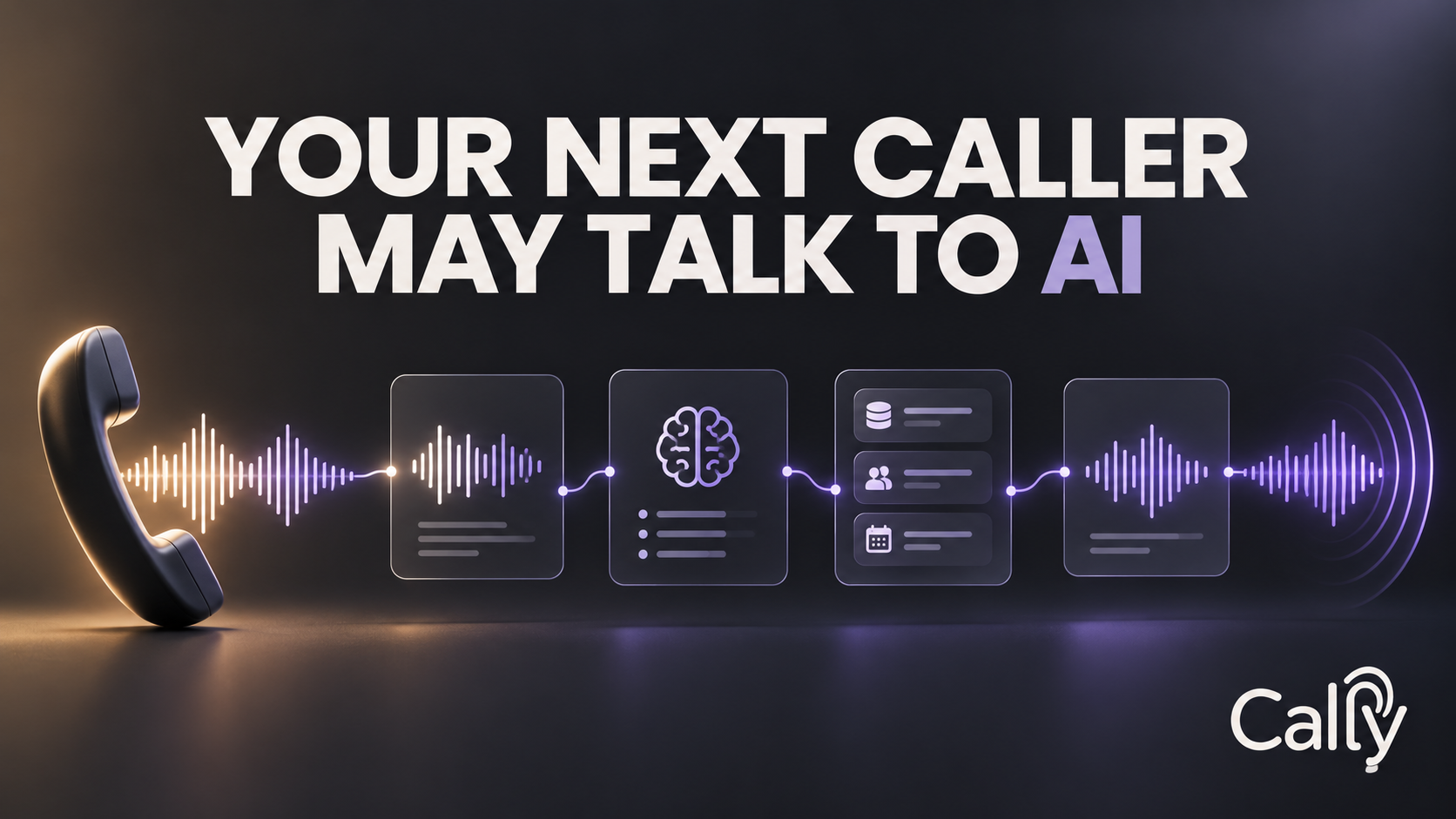
An AI voice agent is more than text-to-speech
An AI voice agent is software that can participate in a phone conversation in real time. It listens to speech, turns that speech into machine-readable text, decides what the caller needs, produces a response, and speaks back with synthetic audio. The useful systems go further: they can retrieve company knowledge, query live business systems, execute approved actions, and transfer the caller to a human when the conversation crosses a boundary. That combination is what separates a real phone agent from a talking FAQ.
The conversation is a real-time pipeline
A phone call leaves very little room for delay. The system has to detect when the caller starts and stops talking, transcribe the audio, generate the next response, and synthesize speech quickly enough that the exchange still feels conversational. Cally is built around this real-time loop, with a native SIP/RTP telephony core, streaming voice activity detection, real-time speech recognition, multi-provider language-model inference, and streaming text-to-speech. The supplied feature sheet describes an end-to-end turnaround target below 600 milliseconds.
Useful agents need knowledge and actions
Answering questions is only one part of customer operations. A caller may want to check an order, change an appointment, cancel a request, or ask for a human. Cally lets teams attach knowledge bases and configure HTTP/REST actions so the agent can retrieve information and interact with business APIs. For sensitive operations, a caller-confirmation safeguard can require explicit verbal approval before the action runs. This turns the voice layer from a passive responder into a controlled operational interface.
A good voice agent knows when to stop being the agent
Automation should not create a dead end. Cally includes native SIP transfer to a PBX queue, extension, or external number, and supervisors can also force a transfer during a live call. The goal is not to keep every conversation inside AI at all costs. The goal is to handle repeatable work well, keep the caller moving, and preserve a clean path to human support for exceptions.
Where voice agents fit first
The best first deployments usually have a clear intent, known data, repeatable decisions, and a measurable outcome. Customer support, appointment booking, lead qualification, order status, and structured outbound follow-up are natural starting points. A team can begin with one narrow call type, test it in-browser, simulate the workflow, review recordings and transcripts, and expand only after the operational behavior is understood.
Cally is designed to let operations teams build, test, connect, supervise, and measure AI phone agents from one platform. Start with one high-volume call type and make the first workflow boringly reliable before expanding.