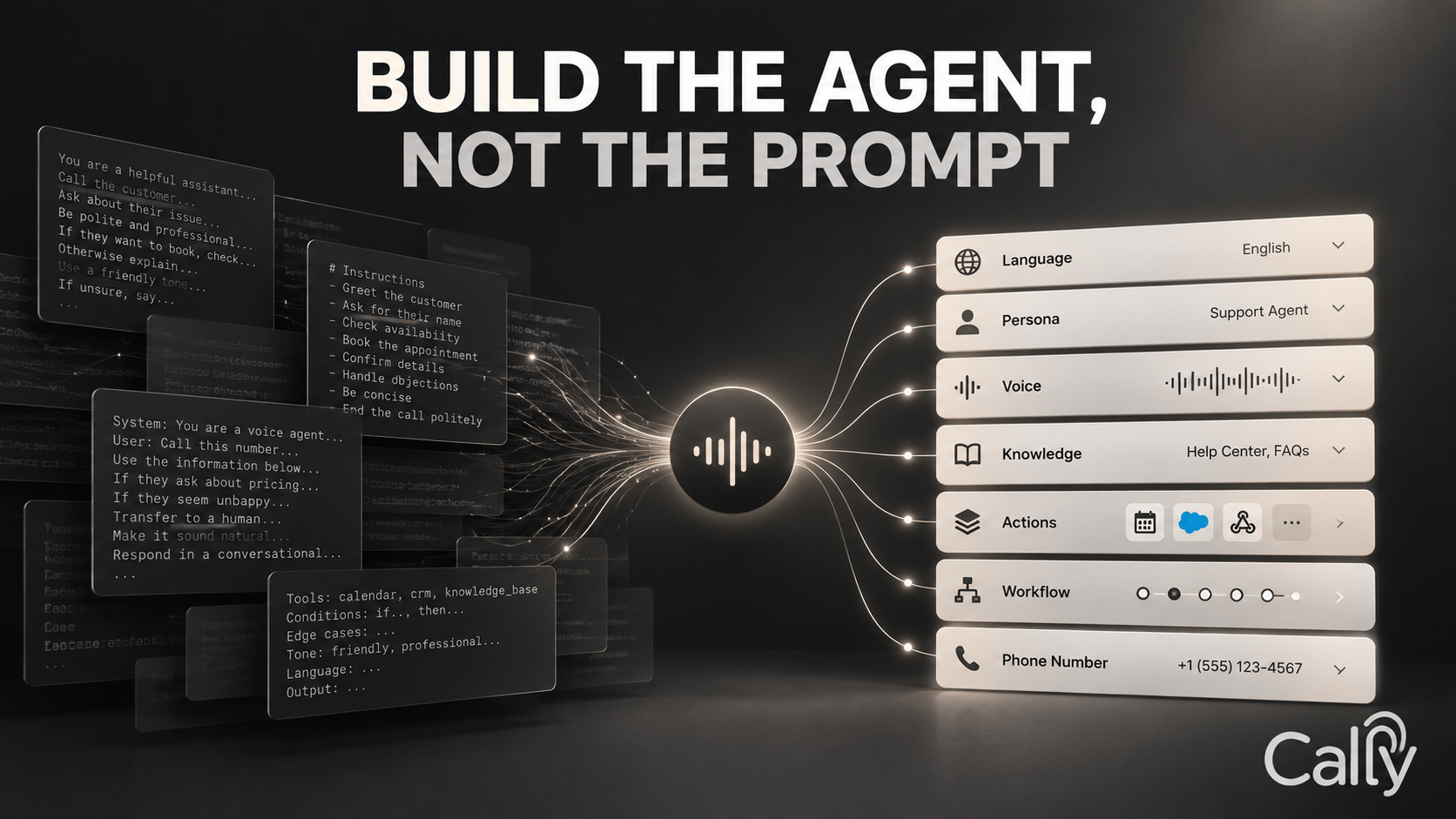
Raw prompts are powerful but operationally fragile
A prompt is a useful development surface, but it is not always a good operating interface. Business teams think in policies, greetings, escalation rules, tone, knowledge, tools, and outcomes. Asking every user to translate those requirements into one long block of prompt text creates inconsistency and makes changes harder to review.
Structured configuration creates repeatability
Cally uses a 12-step creation wizard that guides teams through language, templates, persona, conversation guidelines, voice selection, knowledge-base attachment, action linking, workflow binding, telephony mapping, and final review. The platform then compiles those settings into structured instructions and fallback behavior without requiring the operator to work directly with raw system prompts.
Templates reduce the blank-page problem
A customer-support agent, appointment-booking agent, lead-qualification agent, debt-collection agent, and order-status agent have different conversation goals. Starting from a template provides a baseline structure while still allowing teams to change voice, tone, knowledge, and connected actions. Templates are especially useful during pilot stages because they give teams something testable immediately.
Testing must be part of building
Configuration is not finished when the form is saved. Cally provides in-browser voice testing and a text playground so teams can hear or simulate the agent before connecting it to a production number. Agent lifecycle controls—Draft, Active, Paused, and Archived—plus automatic version capture make it easier to treat changes as controlled releases rather than invisible prompt edits.
The goal is governed flexibility
No-code should not mean no control. A good builder should make common decisions easier while preserving technical depth underneath. Operations teams can own the conversational configuration, while technical teams can still define API actions, SIP routing, knowledge sources, and workflow logic. That separation lets more people contribute without giving every user the keys to the full stack.
If the person who understands the customer process cannot safely configure the agent, the platform is creating a new dependency instead of removing one.