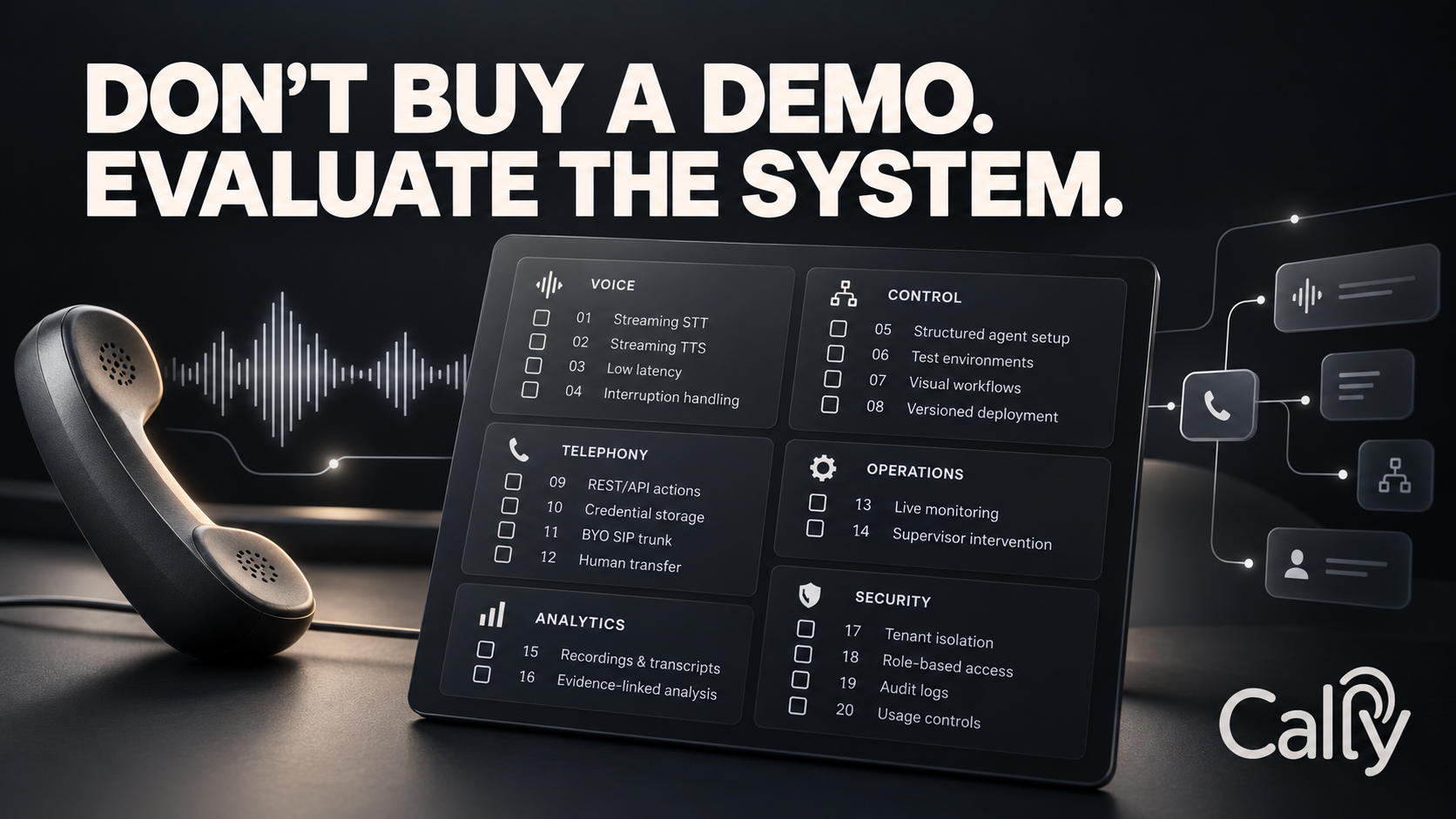
1-4: Real-time conversation
Ask whether the platform supports streaming speech recognition and synthesis, low-latency turn-taking, caller interruption, and fallback when an inference provider is slow or unavailable. Request end-to-end call latency, not only model latency.
5-8: Agent control and workflows
Check for structured agent configuration, test environments, visual workflow orchestration, and versioned deployment. Teams should be able to combine natural conversation with deterministic questions, decisions, confirmations, actions, and handoffs.
9-12: Integrations and telephony
Evaluate REST/API function calling, safe credential storage, bring-your-own SIP trunk support, and native human transfer. A strong voice platform should fit existing systems rather than turning every pilot into a migration project.
13-16: Operations and analytics
Look for live call monitoring, supervisor intervention, dual-channel recordings/transcripts, and structured post-call analysis with evidence. If the system cannot explain what happened during a failed call, production debugging will be slow.
17-20: Governance and scale
Confirm tenant isolation, role-based permissions, audit logs, and usage/billing controls. Then ask how onboarding, localization, campaign pacing, feature flags, and infrastructure monitoring are handled as more teams and call flows move onto the platform.
How Cally maps to the checklist
Cally’s supplied capability matrix covers each of these layers: a low-latency SIP voice core, no-code agent creation, workflow orchestration, REST actions, confirmation safeguards, SIP transfer, outbound campaigns, live supervision, post-call analytics, multi-tenancy, RBAC, audit logging, billing, guided onboarding, and a dedicated superadmin operations layer. The useful question is not how many feature boxes exist—it is whether those layers work together as one operational system.
Use the checklist in a live proof-of-concept. Make the vendor show the whole path: incoming call, knowledge or API lookup, action, interruption, handoff, recording, analytics, and audit trail.