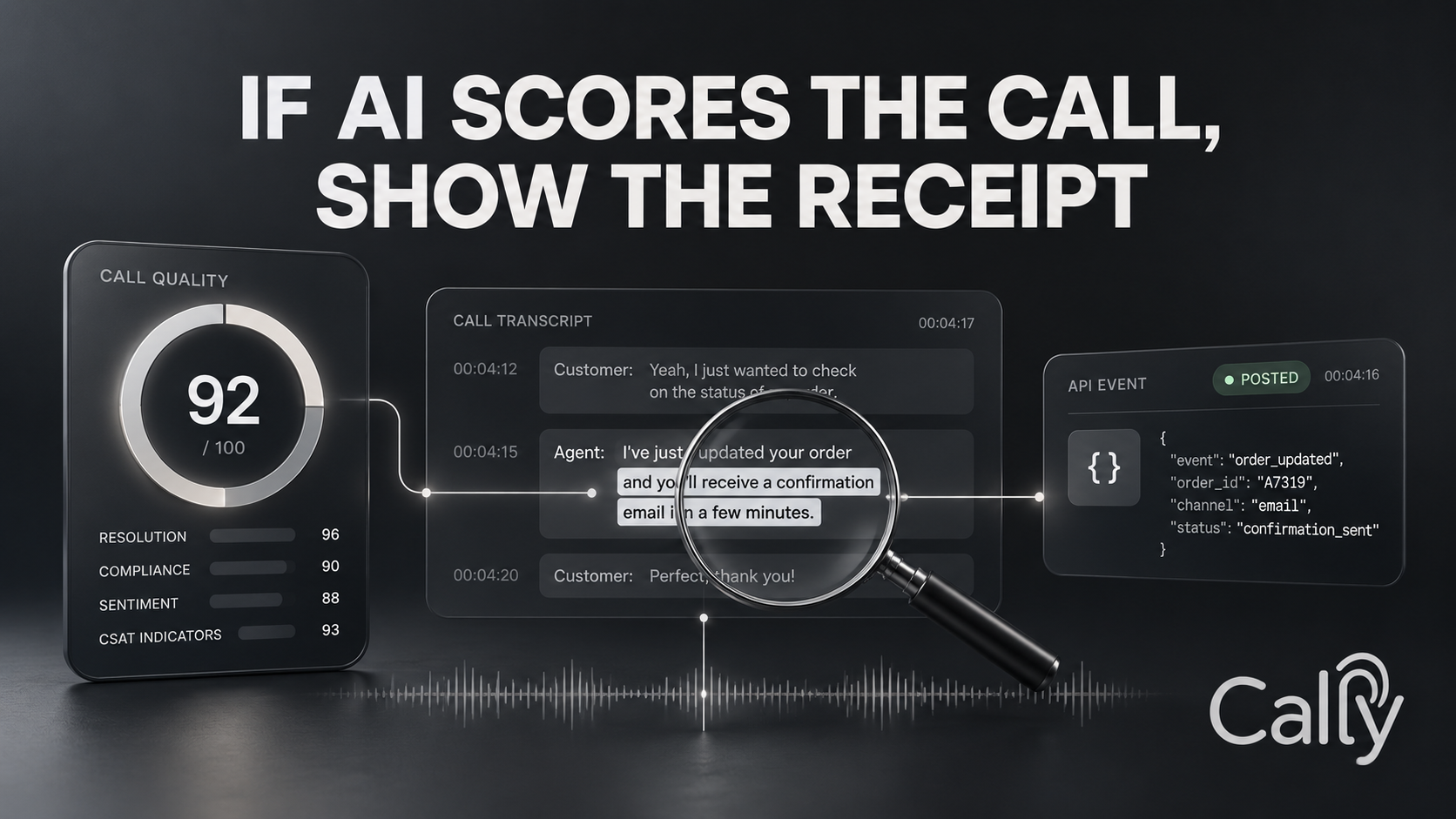
Automated QA creates a new review problem
Using AI to analyze every call can dramatically increase coverage compared with manual sampling. But it introduces another question: why did the analyzer assign that score? If a supervisor cannot inspect the basis quickly, the team simply replaces one black box with another.
Evidence shortens the path from signal to verification
Cally’s analytics can link an evaluation or insight to the exact conversation turn or tool execution where the evidence occurred. A supervisor reviewing a “Failed” call does not need to scrub through a long recording or search an entire transcript. They can start at the moment the system believes the failure happened.
Tool events are part of the conversation truth
Many call outcomes depend on an external system. The agent may say a cancellation succeeded because an API returned success—or because it misread a response. By preserving action execution history and highlighting tool events in the transcript, Cally gives QA reviewers visibility into both what was said and what the system actually did.
Evidence also helps improve prompts and workflows
When the same type of failure repeatedly points to one workflow node, one knowledge answer, or one action response, the problem becomes actionable. Teams can change the specific component rather than rewriting the entire agent. Evidence turns post-call analytics into a debugging loop.
Human review becomes higher leverage
The goal is not to remove people from quality assurance. It is to use automation to narrow attention. AI can review every call, surface outliers or failures, and point to evidence; supervisors can focus their time on judgment, policy, and improvement.
A QA score should always answer two questions: “What happened?” and “Where can I verify it?”