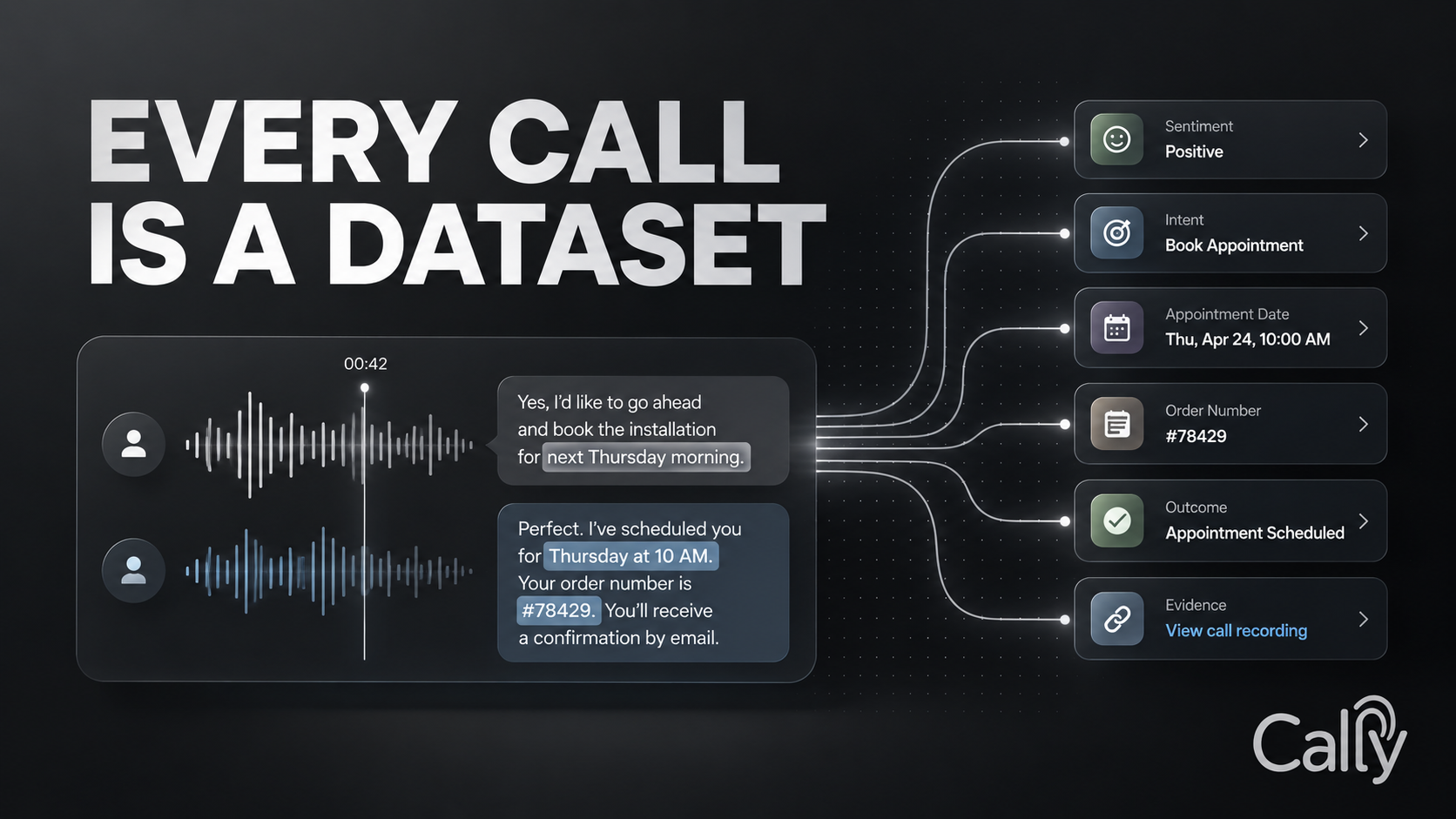
Phone calls contain valuable information that often disappears
A customer can explain a problem, reveal an objection, confirm a date, mention a competitor, or express frustration—all inside one call. If the only output is a recording, most of that information remains inaccessible unless someone listens manually.
Separate audio improves review quality
Cally records caller and agent audio on separate channels and provides a dual-channel waveform player. The transcript is time-coded and identifies the caller and AI separately, including tool-call events. That separation makes it easier to investigate overlap, interruptions, recognition errors, and the exact sequence around an external action.
Post-call analysis can standardize review
Cally runs an asynchronous post-call AI review that returns structured output. It can classify goal attainment as Success, Partial Success, Failed, or Unknown, detect sentiment such as Positive, Neutral, Negative, or Frustrated, and extract defined fields such as dates or order identifiers.
Structure turns calls into workflow inputs
Once a call produces reliable structured fields, those fields can feed dashboards, CRM updates, follow-up queues, QA samples, or campaign analysis. The transcript remains the source material, but operations teams no longer have to start every analysis by listening from second zero.
The raw evidence still matters
Automated summaries and classifications are useful, but they should not become unquestionable truth. Cally includes links from insights back to the exact transcript turn or tool execution that supports the result. That keeps the analytical layer connected to observable evidence.
Choose five fields that matter operationally and extract them consistently. Do not start by trying to label everything a call could possibly contain.