Voice makes inference reliability visible
A web application can retry quietly or show a spinner. During a phone call, an inference timeout becomes dead air. That makes provider latency and availability part of the customer experience, not merely an infrastructure metric.
A single provider creates a single failure mode
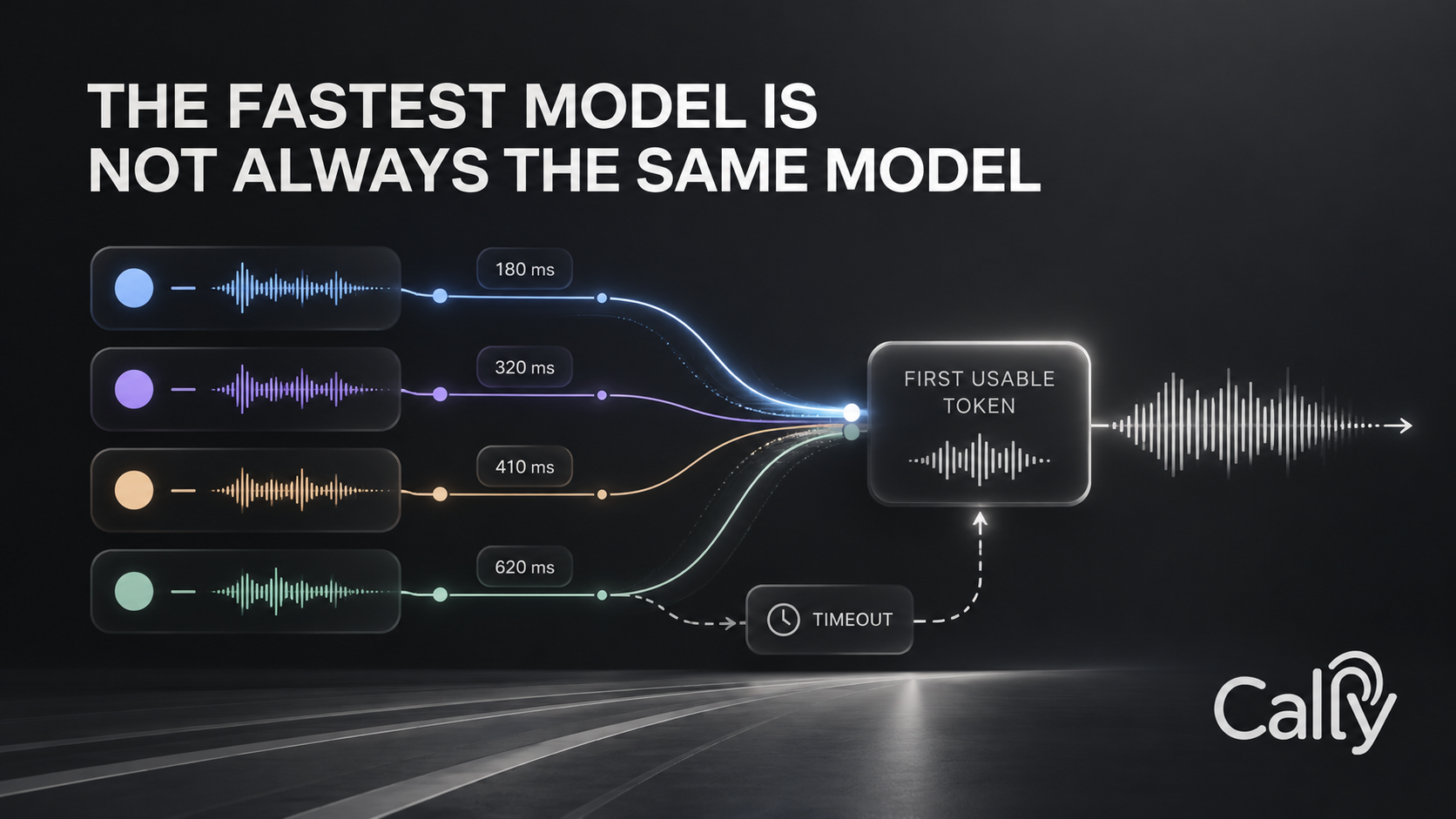
Cally supports multiple inference providers and models, with a primary provider plus alternatives. The platform includes a parallel race mode that can send work to multiple providers and use the first viable response, as well as automatic fallback when a provider experiences network timeouts.
Race mode is about first-turn responsiveness
The value is not that every model must generate a full duplicate answer. In a real-time system, getting a useful first token quickly can reduce audible delay. The architecture can then apply quality, cost, and policy rules around which provider is appropriate for a given workload.
Fallback has to preserve conversation state
Switching providers only helps if the new request carries the same system instructions, conversation history, tool context, and output constraints. A voice platform should treat provider choice as an implementation detail under a stable agent configuration rather than forcing operators to rebuild behavior for each model.
Measure the system, not the provider marketing page
Provider benchmarks are useful inputs, but production metrics should include first-token latency, total response latency, timeout rate, failover frequency, quality under your prompts, and the downstream effect on text-to-speech. The caller experiences the orchestrated system, not the name of the model endpoint.
Build voice AI so a model provider can be changed without changing the customer experience. Resilience starts with architecture, not a backup spreadsheet.