The same answer can work in chat and fail on a call
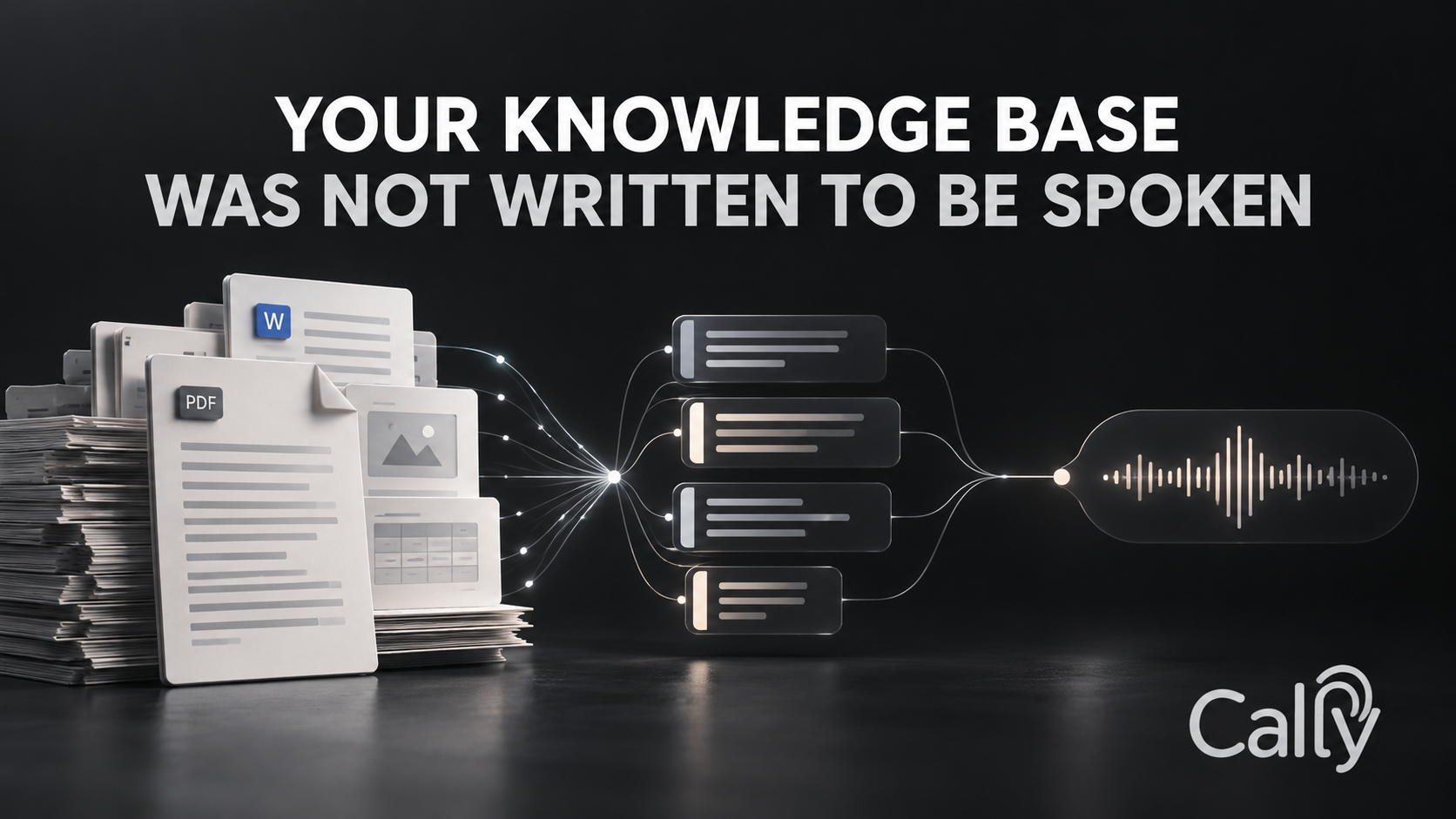
Written support content often contains tables, headings, disclaimers, cross-references, and long paragraphs. A chatbot can display that structure and let the user scan it. A phone agent has to speak the answer in sequence. If it simply reads retrieved text aloud, the caller may get a technically correct response that is exhausting to follow.
Voice RAG needs two transformations
First, the system has to retrieve the right source material. Second, it has to transform that material into a form appropriate for speech. Cally’s knowledge-base module supports PDF, DOC, DOCX, and TXT ingestion, automated text extraction and semantic chunking, and a search-test playground for checking retrieval before the knowledge is attached to an agent.
Retrieval quality should be tested before launch
A document being uploaded successfully does not mean the agent can answer from it reliably. Teams should test real user questions, abbreviations, incomplete phrasing, and common terminology. The search playground gives operators a way to see whether the expected chunks are being retrieved without placing a call. Weak retrieval can then be fixed at the source document, chunking, or content level.
Spoken answers should be compressed
Cally’s voice-optimized RAG injection is designed to condense retrieved context into concise, natural snippets before it reaches the spoken response. That matters because voice answers benefit from short sentences, explicit sequencing, and limited branching. The agent can always offer more detail after the caller signals that it is needed.
Knowledge and live data are different tools
A knowledge base is ideal for policies, procedures, product explanations, and static documentation. Live order status, balances, appointment availability, or account state should usually come from a connected API action. Combining RAG with function calling gives the agent both institutional knowledge and current operational facts without forcing one system to do the other’s job.
For your first voice knowledge base, choose a small document set and test the twenty questions customers actually ask—not the questions the documentation was written to answer.