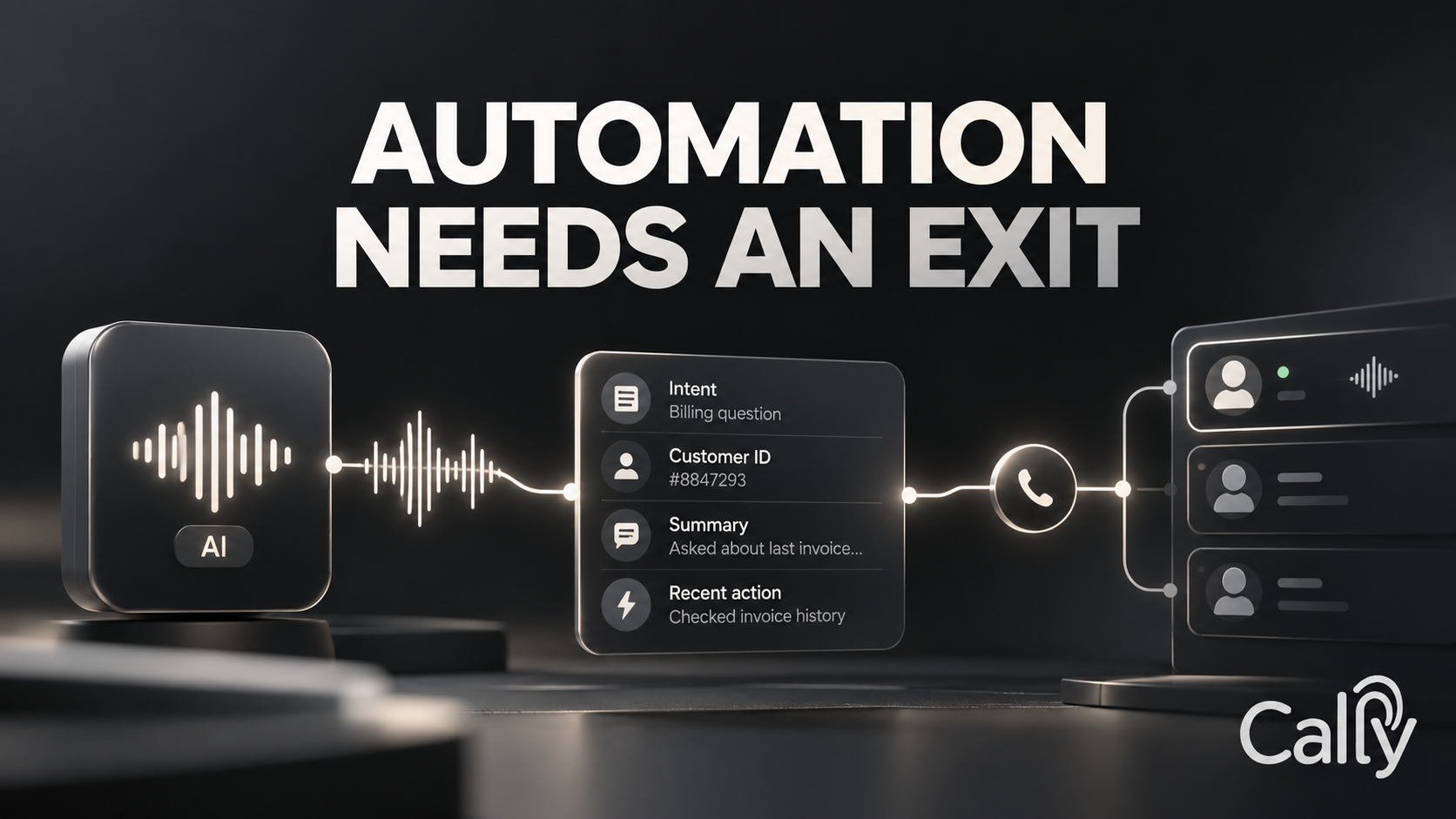
A transfer is part of the product, not a failure state
The best automated call is not always the call that never reaches a human. Some issues are ambiguous, sensitive, emotional, or outside the system’s permissions. A voice agent should recognize those boundaries and move the caller to a person without forcing them to start over.
The trigger should be explicit
Handoff can be driven by caller request, low confidence, a failed action, a workflow branch, business policy, or supervisor intervention. Cally’s orchestration studio includes handoff nodes, and the agent action layer includes a native transfer_to_human action. Making the trigger visible helps teams review why automation ended.
Telephony matters at the moment of transfer
Cally uses SIP REFER to transfer a call to a PBX queue, extension, or external DID, with configurable transfer timeout and fallback retention. This is different from simply starting a second disconnected call. The telephony layer has to preserve a coherent customer experience when control moves from the AI system to the existing contact-center environment.
Context should follow the caller
A human agent should not have to ask, “How can I help you?” after the customer has already explained the problem to the AI. The handoff design should package the caller’s intent, key extracted fields, recent tool results, and relevant transcript summary for the receiving system or agent desktop wherever the integration allows.
Always design transfer failure
Queues can be unavailable. Extensions can reject a transfer. Networks fail. Cally includes timeout and fallback behavior so the AI can retain the call if the transfer does not complete. The caller should receive a clear explanation and a next option instead of silence or an abrupt disconnect.
Measure handoff quality by how little the caller has to repeat—not by how rarely handoff happens.